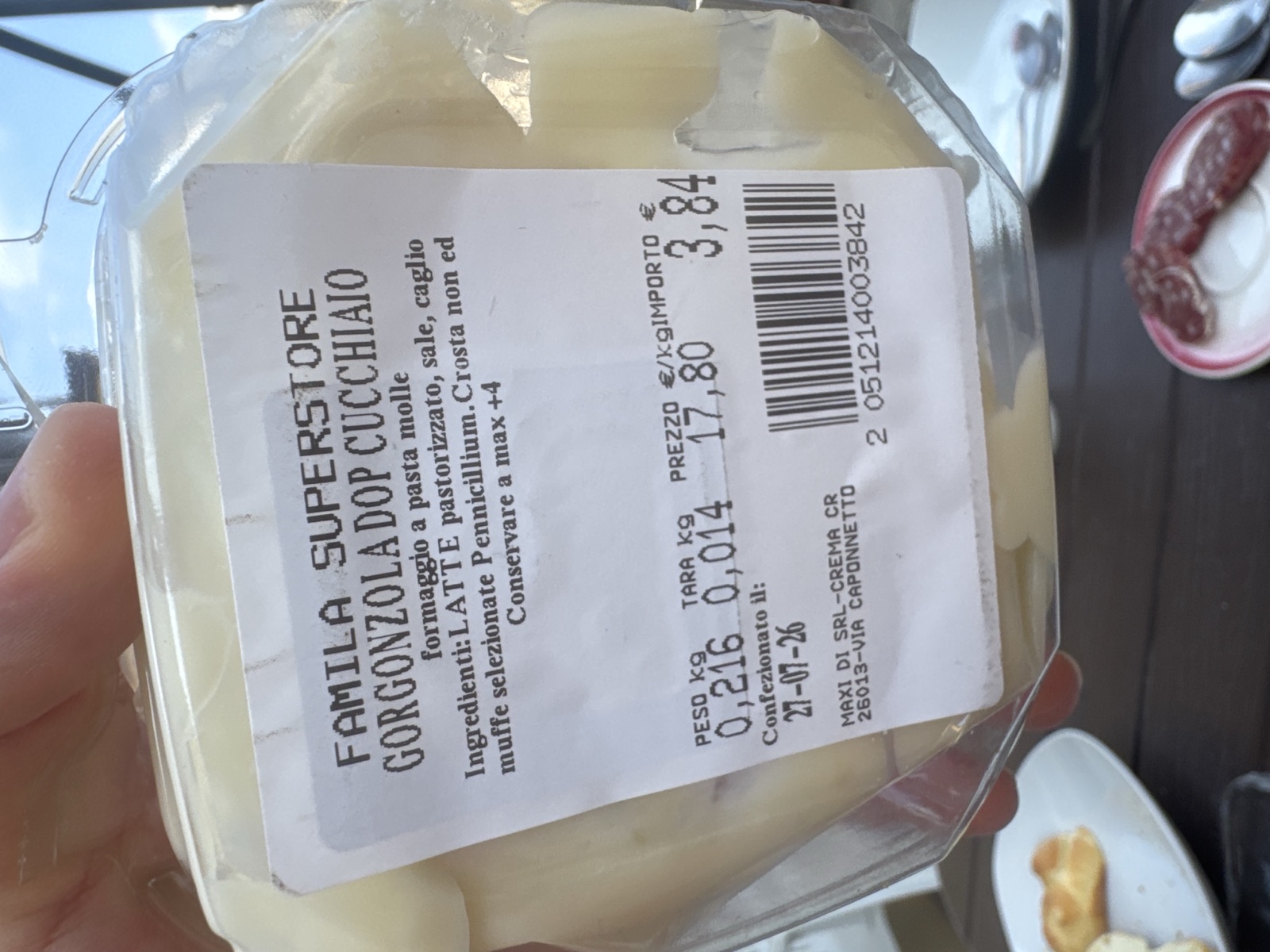
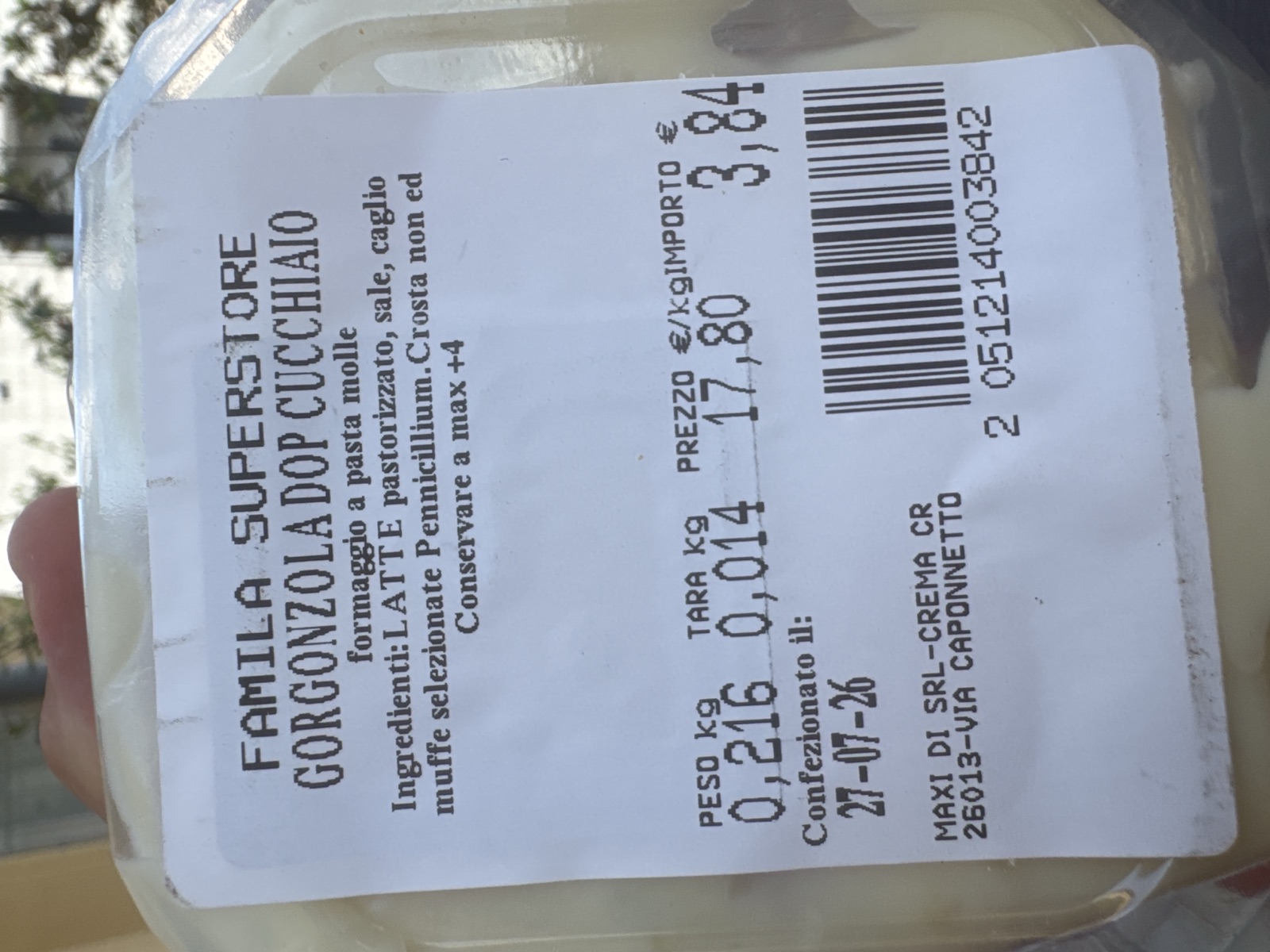
I am writing this on a terrace in Crema, Lombardy, and on the table in front of me is the best €3.84 I have spent all summer: a 216-gram tub of Gorgonzola DOP al cucchiaio — spoon Gorgonzola — from the Famila supermarket down the road, packed the day before we bought it. It is morning, it is already hot, and the cheese is slowly collapsing onto its plate like it knows something we don’t. You eat it with a spoon. That is not decadence; that is the manufacturer’s serving suggestion.
The label is four ingredients long: pasteurized milk, salt, rennet, selected Penicillium molds. That last one is the entire story. Gorgonzola is named for a small town just east of Milan where — legend says, and the legend has a date, 879 AD — herds used to rest on their long autumn walk down from the Alpine pastures. Tired cows — stracche in the old dialect — gave milk for a soft cheese called stracchino di Gorgonzola: the cheese of the tired. The blue came later, says the other legend, courtesy of a young cheesemaker so lovesick he abandoned his evening curd, then stirred it into the next morning’s batch to hide the mistake. Weeks later the wheel came out veined with green-blue mold, somebody brave tasted it, and northern Italy has been grateful to that distracted boy for a thousand years.
Italians call blue cheeses erborinati, from erborin — “parsley” in old Milanese dialect — because the veins look like chopped herbs. They don’t happen by themselves: at about four weeks each wheel is pierced top and bottom with steel needles (the foratura) so air rushes in and the mold blooms along the channels. Age it 50 to 80 days and you get dolce — sweet, spoonable, barely blue. Age it longer and you get piccante — firm, crumbly, and loud. The name has been protected since 1955, a DOP since 1996: only milk from a short list of provinces in Lombardy and Piedmont may become Gorgonzola, about five million wheels a year, most of them made around Novara these days. But the province of Cremona is on that list, and Crema is in Cremona — which means the tub on this table is, technically and gloriously, local produce.
The Italians have a proverb: al contadino non far sapere quanto è buono il formaggio con le pere — don’t let the farmer find out how good cheese is with pears. Too late. Gorgonzola wants fruit and crunch and something sweet: pears, walnuts, a thread of honey, polenta in winter, risotto if you’re patient. At home it goes into the Gorgonzola sauce already on this blog. Here, with the church bells and the heat and Irma’s terrace, it goes onto bread. And, fine — straight onto the spoon.
The Board
Serves: 4 • Time: 10 minutes (plus 30–60 min out of the fridge)
Ingredients
- 200 g Gorgonzola dolce DOP (al cucchiaio if you can find it)
- 100 g Gorgonzola piccante DOP
- 2 ripe pears (Abate or Williams)
- A handful of walnuts
- Runny honey (acacia is perfect)
- Crusty bread or focaccia
Instructions
- Temper: Take the cheese out of the fridge 30–60 minutes ahead. The dolce should slump — that is the whole point.
- Slice: Cut the pears into thin wedges, crack the walnuts, slice the bread.
- Assemble: The dolce gets a spoon, the piccante gets crumbled. Drizzle the honey over the piccante.
- Combine: Dolce + pear. Piccante + walnut + honey. Bread underneath everything. Repeat until gone.
Notes
- Buying: look for the DOP mark on the embossed foil. Dolce is mild, creamy, spoonable; piccante is firmer and sharper. When in doubt, buy both and hold a family referendum.
- The rind is not eaten — our label says it outright: crosta non edibile.
- Real Gorgonzola DOP is made with animal rennet, so it is not vegetarian.
- Keep it wrapped in its foil in the fridge and eat it within a few days. It doesn’t go off so much as it gets louder.